

All-In on the Caspian: My First Poker Tournament in Baku
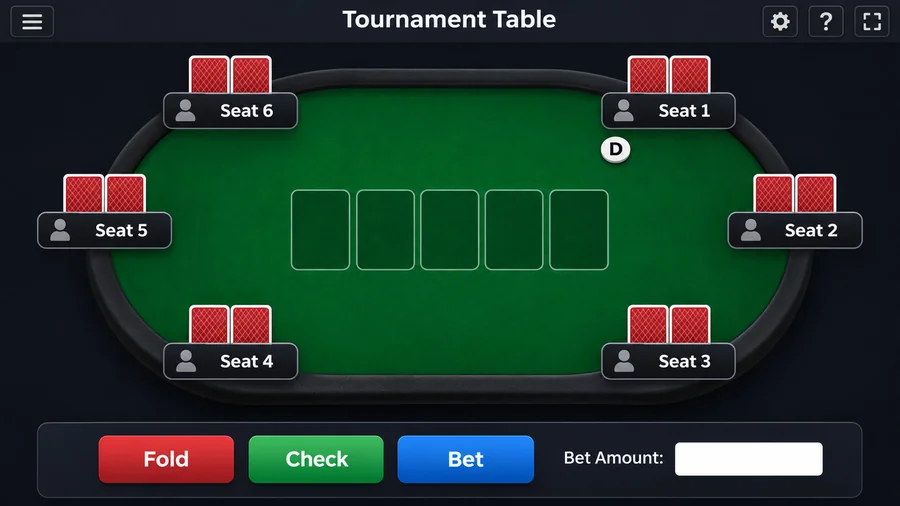
Tournament poker is a curious fusion of science and after-hours cabaret. Every poor decision has a cost. My first tournament in Baku offered a fresh perspective on this fascinating realm of human decision-making.
| Poker Rule | Requirement |
|---|---|
| 🃏 Hand ranking | Best hand wins |
| 🔄 Turn order | Act in turn |
| 💬 Declarations | Speak clearly |
| 💰 Betting | Meet minimum |
| 🤝 Call | Match the bet |
| ⬆️ Raise | Increase bet |
| ✋ Check | No bet pending |
| 🏳️ Fold | Forfeit hand |
| 🏆 Side pot | Eligible bets |
How I Ended Up at the Felt
The journey was far from linear. Backpacking around Asia, a writer's notebook filled with local stories and an events producer's fascination with show business. Although Baku has always intrigued me — caravans, oil barons and Caspian gales, it was news that Baku held mixed card games in its casinos that anyone could join which prompted me to book my flight. Add to this a loan of money, a hotel room on the Boulevard and a morning's stroll to the Felt and, as they say in the archive world, the rest is history.
The Theater of the Felt
Picture a theater without a curtain, in which the audience has a stake in the poor performance of its stars. Felt tables are lined up methodically. Dealers maintain the impassive composure of seasoned diplomats. Levels are timed on a wall clock, like an uninvited metronome. With more notebooks than poker chips at my disposal, I was neither at the forefront nor the back of the pack but just in the middle — as befits a narrative about one’s first tournament.
Players bet according to a nonverbal language. Raised arms and a gliding hand represent particular actions. This ancient system is understood by all, irrespective of age or background. Like Baku itself, which has seen caravans, oil barons and even empires rise and fall, so too does the felt table.
While I was certainly interested in the cards, it was the theatrics which initially most engaged me.
"In Baku, poker isn't just math and bluffing—it's pure theater, where a flicker in someone's eyes gives away the bet before the chips hit the felt."
All are simultaneously cast and audience in this performance.
One Hand, Four Verbs
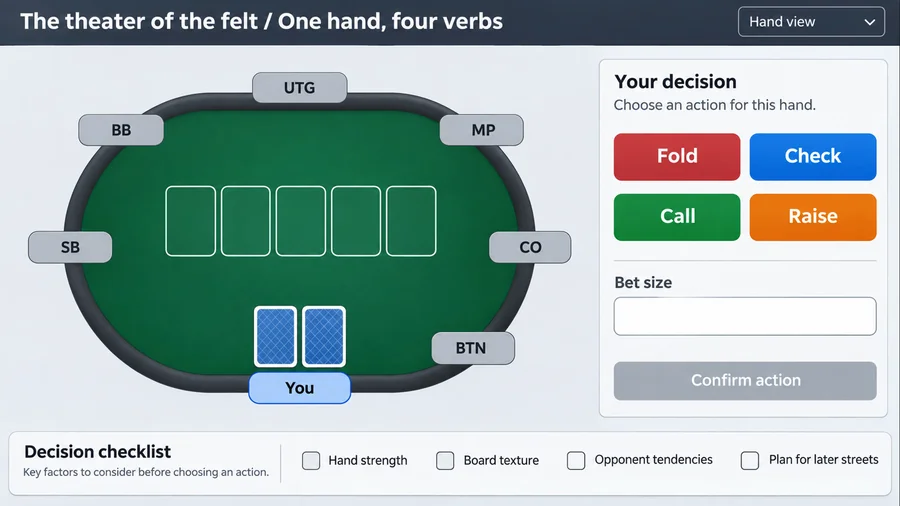
Beyond the glamour, there are four verbs involved in tournament poker. The Poker Tournament Directors Association (the body which writes the industry's rules — the 2026 edition of which came into effect in September) states that the key terms are bet, raise, fold, check. It also stresses that players’ intentions should be clearly conveyed and that they should play in turn.
| Action | What It Means |
|---|---|
| 🂠 Fold | Surrender the hand; whatever you have already put in stays in |
| ✋ Check | Pass the action along when no bet stands against you |
| ⚖ Call | Match the current bet and see where the hand goes |
| ⬆ Raise | Add more to the pot and force everyone else to make a fresh decision |
Each is akin to a brief official statement from an intransigent government which refuses to release historical records. Although a fold indicates a player's decision to quit, it provides little information about the thinking which led to that decision. A raise, by contrast, conveys (or at least, the appearance of) assurance. The rules stipulate that statements must be clear, the actuality is left to the individual.
Reading the Room Without Trusting It
While all card rooms have their own "climate", the skill is in analyzing this without allowing it to dictate one's actions.
What a Beginner Actually Watches
While the cards are not of primary interest, a novice will often analyze how swiftly or slowly a player acts following a bet, how they look at either their opponent or the chips, and the contrast between someone who leans forward and another who handles their cards with highly stylized calm. As an ethnographer might, I began to compile my own observational notes.
Notes which a novice might record include:
- Speed of response — the rate at which a player acts post-bet.
- Visual focus — where a person directs their eyes (if at all).
- Chip handling — how chips are manipulated before and after a decision is reached.
- Body language — the straightening or relaxing of the back in response to a new card.
People can act theatrically, and a slow call may well be either genuine or artificially induced. As noted in the margin of my notes, inherently, body language is open to misinterpretation. It is thus always best analyzed as data, not as evidence.
A Decision, Played Out Step by Step
Within a player's mind, a micro-committee of optimism, numeracy and paranoia convenes an emergency meeting.
How One Hand Forces Every Choice into the Open
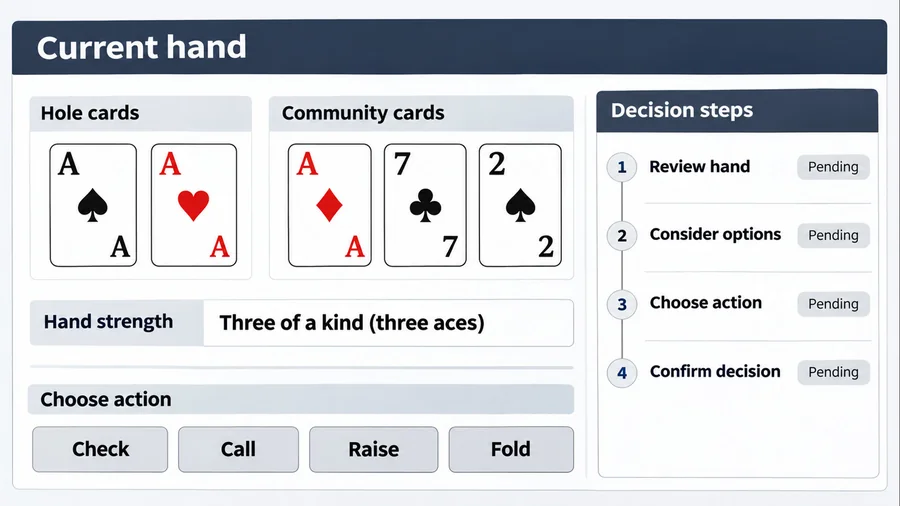
At a mid-tournament stage, one particularly pertinent hand arose. Numbers of players had been whittled down and so each decision had increasing significance. I had been dealt a hand worthy of interest, but not idolatry. There were still three players in the pot. And now, my decision could no longer be postponed.
Below is the process by which a conscientious novice analyzes their situation.
- Analyze your hand in relation to the board. Rather than basing this on optimism, relate it to what the community cards are likely to have just improved.
- Calculate the cost of continuing. This is the number of tournament chips that a call or raise would entail, and how this relates to the number of chips which must be retained for subsequent hands.
- Assess your opponents. Identify who has been playing tight or loose. Consider whether their last three moves have been logically or illogically aligned with your current situation.
- Select one of the four verbs and state it unambiguously. As noted above, the rules apply equally to you as to others in this respect.
Thus, tournament poker has an unusual characteristic: it externalizes decision-making. Whether in the U.S. or on the Caspian, the result is an organized, if somewhat formal, "self-help" course in decision-making.
While the result of a game is important, it is the unusual nature of the pressured decision-making process which is of greater interest. Crucially, however, each decision was discrete and in the strictest sense a bet on an individual's analysis of an unpredictable world.
The Limits of the Tell
Hollywood would have us believe that a twitching eyebrow is practically the same thing as a written confession; in reality, however, people have—regrettably—never been quite so "forthcoming."
A Signal Is Not Proof
Novices often believe that they possess a sixth sense for analyzing people. Much of the poker literature describes glib "gurus" who can deduce all relevant information from a single glance. In reality things are quite different.
| Observation | Possible Interpretation | Why It’s Not a Guarantee |
|---|---|---|
| 👁 A long stare at an opponent | A show of strength, or a search for weakness | Confident players stare; so do uncertain ones |
| 💨 A sudden fast bet | A strong hand that wants action | Impatience also mimics strength deliberately |
| 😐 A perfectly still face | Nothing to read | Stillness can be trained, or simply exhaustion |
| 🤥 A story that contradicts earlier bets | A bluff in progress | Earlier bets may have been the misdirection |
My analysis was about process rather than strategy; I recognized that a tell is essentially conjecture. Evidence is located elsewhere. Those who have worked within (literal or metaphorical) archives will be familiar with this. Although data exists, it is often incomplete. Analysis is undertaken by us. And it is our own confidence which we impose upon it.
From the Room
Although I didn't win any cash, according to the emotionless statistics that chart results at Baku tournaments, I’d fallen somewhere between average and eliminated. However, for a brief period I exuded great wealth, much like someone who has been allowed by security to overstay their welcome in a museum — even though the museum has now closed.
While I hadn't expected the entertainment value of the evening to be so high, I was greatly struck by my lack of self-control. The casino becomes a lecture theater, but one with a sexy theme. Each hand is an investigation into how people, armed with partial knowledge, can be induced to vocally select one of four different verbs. Members of the public then analyze the subject's lack of confidence. Apart from my observations about cards, my notebook (which had been to more countries than I had) recorded behavior related to reaction time, chip manipulation and even posture. Again, all interesting but not evidential. Rather than simply being a spectator, I had unwittingly signed up for an underground masterclass in rapid decision making — and paid my fees in chips.
Of all the experiences, however, it was Baku itself which left the most lasting impression. A city which has for so long seen caravans, oil magnates and even nations risk all they own upon the fortunes of the Caspian, has little time for a newcomer's folklore. There was a polite, organized and almost ritualistic air to the casino; it was as if diplomats were shuffling cards.
So rather than leaving with chips, I departed equipped with strategy. Study a situation. Assign value to your beliefs. Recognize that, although tells can be informative, they are still only hypotheses. And above all else, realize that each choice is in itself a specialized gamble within a world which is notoriously difficult to decipher. The casino retained my funds, it gave me something far more lasting; an education in writing, doled out in sections, on the distant Caspian shore.
